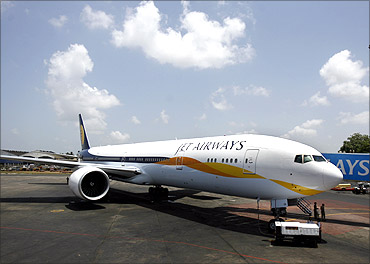
Refuting all the allegations, IOC has clarified that no monopolistic situation exists in supply and pricing of aviation turbine fuel (ATF) to airlines.

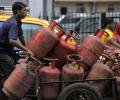
Aviation turbine fuel or jet fuel price was on Wednesday hiked by a steep 9.2 per cent, while that of non-subsidised cooking gas was raised by Rs 21 per cylinder.

Airfares on major domestic routes such as Kolkata-Bagdogra, Delhi-Bengaluru, and Delhi-Mumbai have witnessed an increase of up to 12.7 per cent year-on-year (Y-o-Y) in May this year, according to data by Thomas Cook (India) and SOTC Travel. The recent increase in aviation turbine fuel prices, rupee depreciation, reduction of flights by key players, and grounding of planes due to engine supply issues have contributed to the rise in airfares, said aviation industry experts. However, the data also shows that summer airfares on key routes such as Delhi-Leh and Delhi-Kolkata have significantly decreased due to the introduction of new flights.

Falling jet fuel prices, stable rupee signal lower losses
Indian airline industry is expecting to prune its net losses to Rs 3,000-5,000 crore in this fiscal from an estimated Rs 17,000-17,500 crore in FY2023 on the back of improved yields and stable cost environment, credit ratings agency ICRA said on Tuesday. At the same time, ICRA also estimated that domestic air passenger traffic will expand by 8-13 per cent each in FY2024 and FY2025. The rating agency has also maintained its stable outlook on the industry in view of healthy passenger traffic growth, improved yields and a stable cost environment.
The domestic aviation industry is expected to report a net loss of Rs 25,000-26,000 crore this fiscal with elevated jet fuel prices and fare caps continuing to pose a major challenge for the airlines' profitability, domestic rating agency ICRA Ltd said on Thursday. The domestic airlines, however, are likely to post a reduced net loss of Rs 14,000-16,000 crore in the next financial year on the back of a "notable recovery" in air passenger traffic and lower level of debt, ICRA said. The ratings agency also estimates that the industry will require an additional funding in the range of Rs 20,000-22,000 crore during FY22-FY24.
The civil aviation ministry is hopeful of further reduction in the price of aviation turbine fuel this year.

The government on Tuesday increased the windfall profit tax on crude oil produced in the country and reduced the levy on exports of diesel. The tax, levied in the form of Special Additional Excise Duty or SAED, on domestically produced crude oil was increased to Rs 9,800 per tonne from Rs 9,050 a tonne, according to an official notification. SAED on the export of diesel was reduced to Rs 2 per litre from Rs 4 a litre and on jet fuel or ATF to nil from Rs 1, the notification said.

Amid record-high fuel prices, Finance Minister Nirmala Sitharaman on Monday said there is no proposal as of now to bring crude oil, petrol, diesel, jet fuel (ATF) and natural gas under the Goods and Services Tax (GST). When the GST was introduced on July 1, 2017, amalgamating over a dozen central and state levies, five commodities - crude oil, natural gas, petrol, diesel, and aviation turbine fuel (ATF) - were kept out of its purview given the revenue dependence of the central and state governments on this sector. This meant that the central government continued to levy excise duty on them while state governments charged VAT. These taxes, with excise duty, in particular, have been raised periodically.
No immediate comment was available from airlines on the impact of the price hike on passenger fares.

Sources aware of the development said as part of the project, the airline had signed an agreement with Reliance Industries Ltd, which would extend quality control services at its coastal terminals for ATF imported by the airline.
Public sector oil firms on Thursday raised aviation turbine fuel (jet fuel) prices by up to 2 per cent, the second increase in three months.

With fewer passengers airlines bracing for a rise in operating costs due to a spike in crude prices
The minister said airlines must reciprocate the government's gesture to help the aviation industry, which has been been going through rough weather this year. State-run oil companies on Monday slashed jet fuel prices by over 11 per cent. ATF in Delhi was cut by Rs 4,208.37 to Rs 32,691.28 per kilolitre.
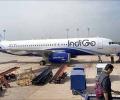
Market leader IndiGo on Friday followed its rivals and raised fares by 25 per cent to offset the impact of rupee fall and spike in international crude prices.
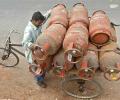
In five monthly reduction, non-domestic LPG rates have been slashed by Rs 170.5 per cylinder, bringing the price at three-year lows.

Corporate margins and profits in India remain vulnerable to changes in crude oil prices in the international market. Historical quarterly data from listed companies (excluding banks, finance and insurance, oil and gas, and power sectors) indicate an adverse correlation between corporate margins and crude oil prices.
The country's largest private air carrier Jet Airways today posted a net loss of Rs 101.22 crore (Rs 1.01 billion) for the third quarter of 2011-12 on account of rising prices of aviation turbine fuel and rupee depreciation.

Jet fuel constitutes roughly 40 per cent of the operating cost of an airline.

India's fuel sales fell in the first half of April as a record rise in prices in a short 16-day period dented demand, preliminary industry data showed on Saturday. Petrol sales fell almost 10 per cent in the first half of April when compared with the same period in the preceding month, while diesel demand slid 15.6 per cent. Even cooking gas LPG, which had consistently shown growth even during the pandemic period, saw a 1.7 per cent month-on-month fall in consumption during April 1-15.

IOC, BPCL and HPCL on Thursday afternoon stopped ATF supplies to Air India at six airports - Kochi, Pune, Patna, Ranchi, Vizag and Mohali - over payment defaults. AI flights from these places were tanking up from other airports.

In a thread of tweets, Mallya claimed, "The airlines struggled financially partly because of high ATF prices. Kingfisher was a fab airline that faced the highest ever crude prices of $ 140/barrel. Losses mounted and that's where banks money went. I have offered to repay 100 % of the principal amount to them. Please take it."
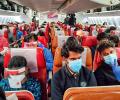
Domestic air passenger traffic plunged around 43 per cent month-on-month at 64 lakh in January 2022 as the third wave of the pandemic and the resultant restrictions by state governments kept flyers away from air travel, Icra said on Tuesday. The domestic passenger volume in December 2021 was recorded at 112 lakh. The rating agency said it is expecting the recovery process to remain subdued during March quarter and that the jet fuel prices continue to be a drag on the sector. The passenger traffic declined 17 per cent last month over 77 lakh passengers transported by domestic airlines on local routes in January 2021, Icra said.

Jet Airways on Friday said it will raise fares by 10-15 per cent as early as this month to offset rising jet fuel prices -- a decision that possibly stems from confidence about returning passenger demand.
The hike in aviation turbine fuel prices is likely to lead to a 10-14 per cent increase in fares on metro routes and long-haul flights. The oil companies hiked ATF prices by 14 per cent as a result of global rise in crude oil prices over the last few months. Now, most airlines, including Jet Airways and SpiceJet, are looking at imposing a differential surcharge - a smaller increase on shorter routes than longer routes.
Air Sahara on Tuesday announced a 10 per cent fare hike with effect from June 21 following an increase in the aviation turbine fuel price.
Jet fuel (ATF) rates were on slashed by a steep 12.5 per cent, the sixth straight reduction in prices since August, as international oil prices slumped to five-year low levels.
Confronted with spiralling aviation turbine fuel prices, which account for half an airline's operating costs in India, several low-cost and full-service carriers will go for a steep increase in fares that could vary from 5 to 20 per cent, from June 20. Today's announcement comes three weeks after fares were raised 8 to 10 per cent following a rise in ATF prices (which increased 18 per cent last month).
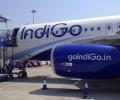
Despite the best ever quarterly net profit of Rs 3,091 crore during April-June of financial year 2023-24 (Q1FY24), challenges are mounting for InterGlobe Aviation-run IndiGo in the near term, said analysts. Given this, most brokerages have retained their ratings from 'buy to underperform', as well as their target price for the stock. For instance, Motilal Oswal Financial Services has retained its 'neutral' rating on the scrip as it believes the low-cost airline is facing teething issues at present.

Consumption-related stocks, such as hotels, and quick service restaurants (QSRs), have been hitting the ball out of the park ahead. On the other hand, the Miss World Pageant scheduled for later this year in New Delhi, too, could provide some tailwind to these stocks, especially hotels and aviation. However, analysts suggest investors put their best foot forward and buy these counters only on a decline given the recent rally and economic headwinds.
Whole price index inflation will touch zero per cent by March end 2009, on the back of 2 per cent excise duty cut, a 7 per cent cut in ATF prices and a strong base effect," Azis Bank said in a note. The report further said that a revival in demand is unlikely to be so strong and inflation might be negative in April 2009.
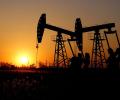
The government has cut windfall gains tax on domestically-produced crude oil to nil while continuing the rate at zero on the export of diesel and ATF. The government has slashed the special additional excise duty (SAED) on crude oil produced by companies such as Oil and Natural Gas Corporation (ONGC) to nil from Rs 4,100 per tonne with effect from Tuesday, an official order dated May 15 said. This is the second time that the levy, which was introduced in July last year in the form of a cess to tax supernormal gains of oil producers and fuel exporters, has been cut to nil for domestically-produced oil.
While higher fuel costs and irrational pricing are key concerns, infusion of funds to retire debt is crucial if Kingfisher Airlines has to improve its financials.
While higher fuel costs and irrational pricing are key concerns, infusion of funds to retire debt is crucial if Kingfisher Airlines has to improve its financials.
At a time when crude oil prices are softening internationally, domestic carriers are raising fares by as much as 10 per cent to boost yields and cut losses. The new rates will be effective from August 1.
Following on the footsteps of Indian Airlines, two leading private carriers Jet Airways and Air Sahara on Monday announced increase in fares in all sectors by 12 per cent from April 15.

The government has brought back the windfall profit tax on domestically produced crude oil after international prices firmed up while the levy on export of diesel has been cut to nil, according to an official order. The levy on crude oil produced by companies such as Oil and Natural Gas Corporation (ONGC) is now Rs 6,400 per tonne with effect from Wednesday, the order dated April 18 said. At the last revision on April 4, windfall tax on domestically produced crude oil was cut to nil as international oil prices dipped below $75 per barrel.

Adding petrol and diesel to GST was a challenging task due to their significant role as revenue generators for both the central and state governments.
